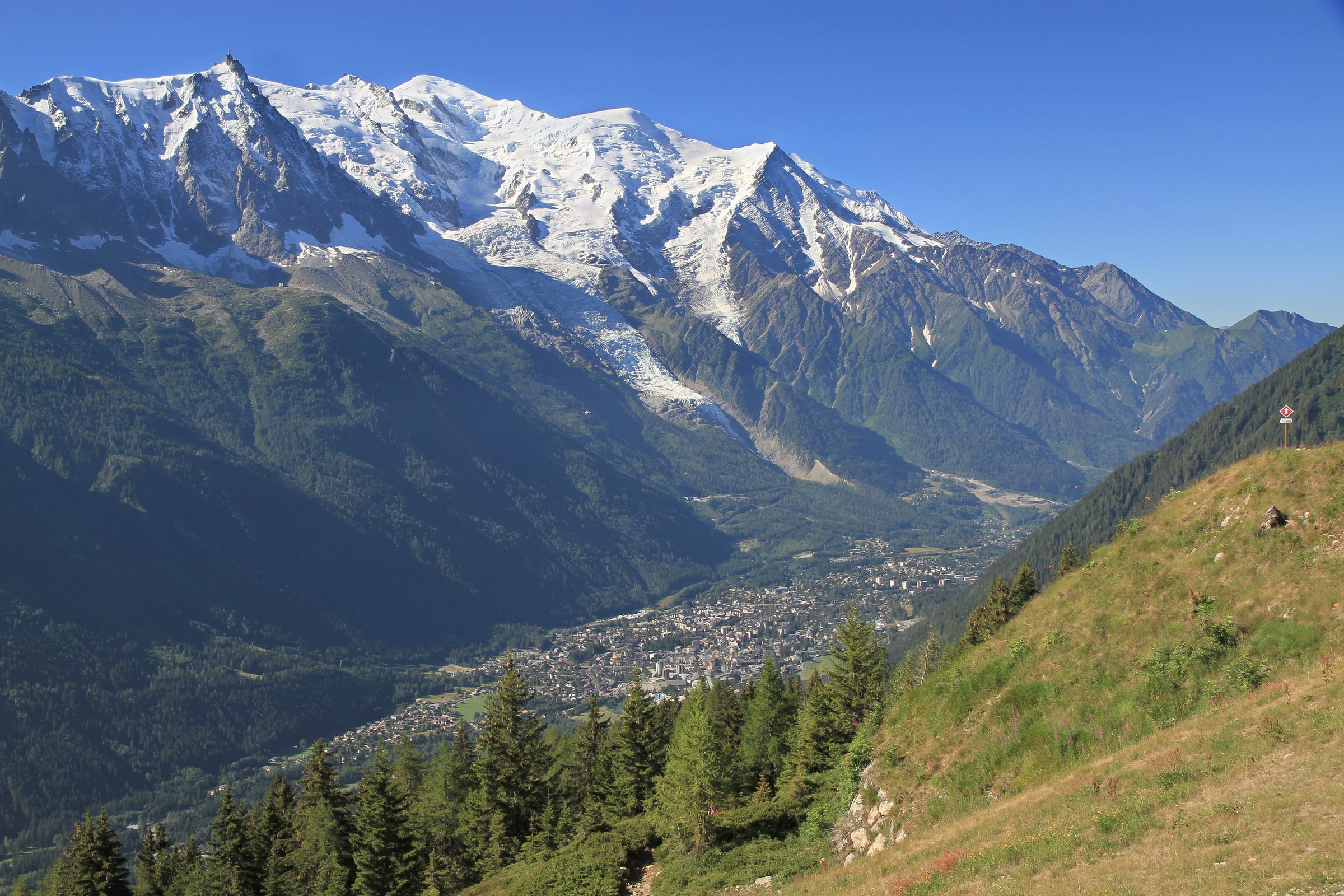
Beneath Mont Blanc: The Alps at Full Height
Chamonix is a mountain town in the Haute-Savoie department of the French Alps, known as the birthplace of alpinism and the gateway to Mont Blanc, the highest summit in the Alps at about 4,800 metres. The valley is walled by granite needles and hanging glaciers, and the town sits in the middle of it, a handsome mix of Belle Epoque hotels, timber chalets and cafe terraces. It hosted the first Winter Olympic Games in 1924, and the sense of a place built around ambition, skill and fresh air has never really left.
The drama is easy to reach. The cable car to the Aiguille du Midi climbs to 3,842 metres and delivers a close view of the Mont Blanc massif, while the Montenvers rack railway rises to the edge of the Mer de Glace, France's longest glacier. Walkers, climbers, skiers and riders all share the same valley, and the town's compact centre and bright river, the Arve, keep everything within a short stroll. Across the tunnel, Courmayeur gives the same mountain a distinctly Italian character, with its own cuisine and pace.
Glacier Descents, Trails and Alpine Tables
Winter in Chamonix is about variety rather than a single linked circuit. The valley's ski areas, including Brévent-Flégère, Les Grands Montets above Argentière, Le Tour and Les Houches, each have their own mood, and the Vallée Blanche, a long off-piste glacier descent from the Aiguille du Midi, is a celebrated classic taken with a guide. For a different pace, Zermatt across the Swiss side offers car-free village charm beneath the Matterhorn, and Verbier a lively big-mountain alternative.
Summer shifts the focus to trails and tables. The Tour du Mont Blanc circles the massif through France, Italy and Switzerland, and the Ultra-Trail du Mont-Blanc, held every late August, fills the town with runners and supporters. Savoyard cooking is part of the pleasure: reblochon, tartiflette, fondue and mountain honey appear in refuges and in the restaurants of the old centre. A tourist board or valley partnership can build a year-round story here, from glacier mornings to festival evenings.
Seasons, Stays and the Road from Geneva
Chamonix works in every season. Winter snow typically runs from December through to April, with the high glaciers offering skiing well into spring, while June to September is the classic window for walking, climbing, paragliding and mountain biking. Stays range from grand historic hotels in the centre to chalets in Argentière and Les Houches, and the Mont Blanc Express train links the valley villages, so a car is rarely needed once you arrive.
Most visitors fly to Geneva and continue by road or shared transfer, a journey of roughly an hour, with direct services from many UK airports. VisitChamonix.co.uk can give hotels, airlines and tour operators a single home for that whole journey. From here the great Alpine resorts are close by, with Méribel and Courchevel in the Three Valleys to the south-west and St Moritz a longer, scenic route east.
Choosing Your Base Across the Valley Villages
Chamonix rewards those who choose a base with care, because the valley is a string of distinct villages rather than a single resort. The town centre suits first-time visitors and culture seekers, with Belle Epoque hotels, pedestrian lanes, boutiques and the Mont Blanc Express station within a short walk. Argentière, at the head of the valley, has a quieter, more mountaineering mood and sits beneath the Grands Montets lifts, which makes it a favourite with keen skiers and climbers. Les Houches, at the western end, is gentler, with wooded slopes and an easy pace that suits families.
Styles of stay are just as varied. Historic grand hotels with spas and terraces facing the Mont Blanc massif sit in the centre, while family-run guesthouses and boutique chalet-hotels line the lanes of Les Praz and Argentière. Self-catering apartments suit groups and extended families, and catered chalets bring a house-party feel for friends travelling together. Le Tour and Vallorcine, at the northern end of the valley, offer a village atmosphere close to the Swiss frontier and the walking routes of the Aiguilles Rouges. An airline partner can pair these choices with Geneva schedules, and Courmayeur gives an Italian alternative for a second base.
Farcement, Mountain Museums and Festival Summers
Beyond the cheese-led classics, Chamonix cooking has a quiet depth. Farcement, a baked potato dish studded with dried fruit and bacon, and diots, Savoyard sausages simmered in local white wine, appear in family-run restaurants, alongside croziflette, tarte aux myrtilles and honey from alpine meadows. Coffee and pastry stops on the Place du Mont-Blanc are part of the daily rhythm. Génépi, the herbal mountain spirit, belongs to the valley's culinary heritage, and many cafés still serve it as a traditional digestif at the end of a long mountain day.
Culture here is rooted in the peaks. The Musée Alpin tells the story of early ascents with ice axes, hobnailed boots and period photographs, and the statue of Horace-Bénédict de Saussure and Jacques Balmat looks toward the summit they first climbed in 1786. Summer starts with the Marathon du Mont-Blanc in late June, the town turns festive on 14 July with fireworks above the valley, and the golden larches of October give the lower slopes their own show. December brings Christmas lights to the centre and the first snow to the high lifts, so each season has its own picture.
Skyways, Ice Caves and Day Trips Abroad
Chamonix is among the most varied active bases in Europe. The Skyway Monte Bianco cable car climbs from Courmayeur's side to Pointe Helbronner, linking with the Aiguille du Midi in summer for a remarkable glacier crossing, and the ice cave cut into the Mer de Glace is reached from Montenvers by a short cabin ride. Walkers choose the Lac Blanc trail for a mirror view of the massif, or the Grand Balcon Sud for a long, level shelf of high-mountain scenery. Paragliders launch from Planpraz and Brévent, and mountain bikers use the valley's marked trails through summer.
Day trips are easy. The Mont Blanc tunnel reaches Italy within the hour, for espresso, Aosta Valley cheeses and the thermal gardens of Courmayeur, while Geneva and Annecy, with its canals and lake, are comfortable excursions by road. Visitors who want a second mountain base can combine the valley with Les Arcs or Val d'Isère in the Tarentaise, or cross Switzerland to Cervinia and Verbier. A week built around a glacier day, a lake day and a spa evening shows why guests keep returning for a second visit.
Planning your stay
Chamonix is a valley rather than one linked ski circuit. Les Houches, with its Kandahar World Cup piste, sits at the valley entrance, Brévent-Flégère faces the town, Grands Montets rises above Argentière and Le Tour and Vallorcine lie at the far end. Most of these areas are not joined by lifts, so skiers move between them by ski bus.
The Aiguille du Midi cable car reaches 3,842 metres and gives access to the Vallée Blanche descent and the Step into the Void glass box. In summer the valley turns to hiking, trail running and the Tour du Mont Blanc. Across the Mont Blanc tunnel, Courmayeur in Italy makes a day trip, while Courchevel, Méribel, Val d'Isère, Les Arcs and Alpe d'Huez offer larger linked ski areas.
When to go
The ski season runs from December to April, with the best snow from January to March. Early season conditions can be thin, and spring offers long days and softer snow, but the lower slopes can be icy or slushy. In summer, from late June to September, the valley is busy with walkers, cyclists and climbers.
Conditions on roads in mountainous areas can quickly become difficult in winter.
Getting there and entry rules
Geneva is the usual gateway, and road transfer times to Chamonix vary with traffic, weather and border queues, so confirm the duration with your provider and pre-book for Saturday changeovers. Trains run up the valley via Saint-Gervais as an alternative.
For a UK visitor, France applies the Schengen passport test: issued within the last 10 years and valid for three months after you leave, with stays capped at 90 days in any 180. Cash or travellers cheques of 10,000 euros or more must be declared, and meat or milk products cannot be brought into EU countries.
Before you travel
Entry requirements and official travel guidance are updated regularly, so check the latest position with your government before booking. The sources we used are listed at the foot of this page.
Why Chamonix matters to the industry
VisitChamonix.co.uk lets a tourist board, hotel group or airline publish accurate guidance, and our AI platform carries it to searchers.
Browse our other destination guides for comparison across the Alps.
Questions travellers ask about Chamonix
How do you get to Chamonix from the UK?
Fly to Geneva, about one hour 50 minutes from London, then take a transfer of about an hour and a quarter. Trains via Saint-Gervais are an alternative.
Is Chamonix good for beginners?
It is better known for steep terrain, off-piste and mountaineering, though Les Houches and Le Tour have gentler slopes. Beginners often choose larger linked resorts elsewhere in the Alps.
Do UK citizens need a visa for France?
A UK visitor needs no visa for Chamonix on a stay of up to 90 days in any 180-day period. Check two dates on your passport before Chamonix: it must be less than 10 years old at arrival and valid for three months beyond your departure from the Schengen area.
What is Chamonix best known for?
Chamonix is best known for Mont Blanc, the highest peak in the Alps, and for being the birthplace of alpinism. It hosted the first Winter Olympics in 1924 and offers the Aiguille du Midi cable car, the Mer de Glace and the Vallée Blanche descent.
How long does it take to reach Chamonix from the UK?
Most visitors fly from the UK to Geneva, with direct flights from many airports, and then travel to Chamonix by road or shared transfer in roughly an hour. Combined with the flight, many guests arrive within half a day of leaving home.
What is there to do in Chamonix on a rainy day?
The Musée Alpin, the town's cafés and boutiques, the thermal and spa facilities in hotels and the Sports Centre pool all make good indoor options. Many guests also take the cable car above the cloud, where the high peaks are often bright.
Where should couples stay in Chamonix?
Couples often choose the town centre for restaurants and terraces, or a boutique chalet-hotel in Les Praz or Argentière for a quieter setting. Those wanting views of Mont Blanc and spa time usually favour the historic hotels close to the centre.
In the Visit Travel Group portfolio: VisitChamonix.co.uk.