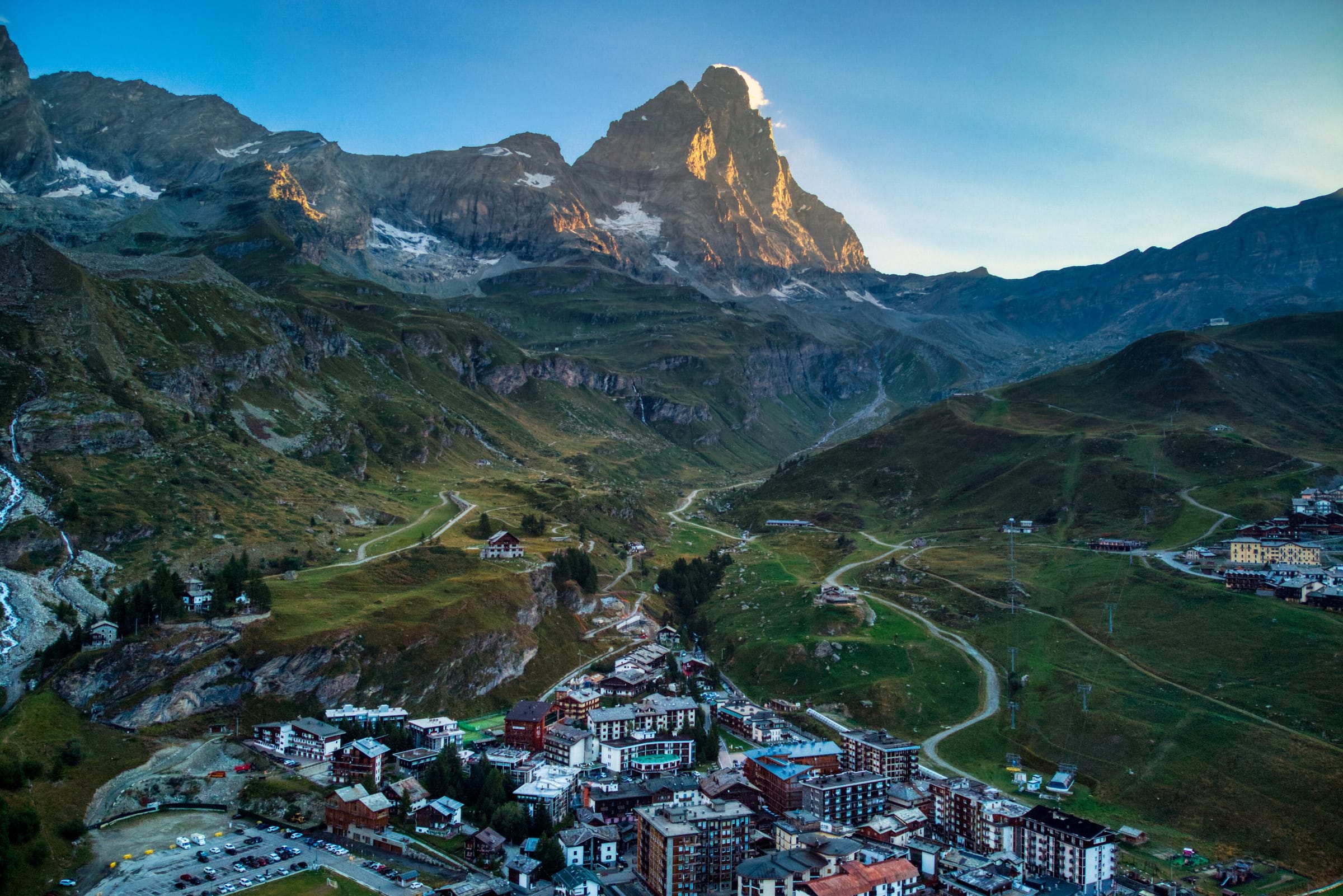
Skiing Beneath the Matterhorn's Italian Face
Cervinia, officially Breuil-Cervinia, is a ski resort in the Aosta Valley of north-west Italy, sitting at about 2,000 metres directly beneath the Matterhorn, which Italians call Monte Cervino. It is known for wide, sunny slopes, long cruising runs and altitude that keeps the snow reliable: the lifts climb to around 3,500 metres at the Plateau Rosa glacier, which allows skiing well into the season and, on the glacier, even in summer. The pyramid of the Matterhorn dominates the village's skyline from almost every terrace.
The resort's headline feature is the link over the mountain to Zermatt in Switzerland. Skiers can cross between the two via the Matterhorn Ski Paradise lift system, enjoying Italian lunches in one valley and Swiss views in the next, a rare opportunity for a two-country day on skis. Intermediates relish the broad pistes, while advanced skiers find off-piste routes and steeper sections around the upper glacier. Beginners benefit from gentle, sunlit nursery slopes right by the village.
Aosta Valley Flavours and Mountain Apres-Ski
Food is a delight. Aosta Valley cuisine brings fontina cheese, polenta concia, carbonnade of beef cooked in red wine and local cured meats such as lardo d'Arnad, all served in mountain refuges and village restaurants. Cervinia's apres-ski is classically Italian: terraces fill at the end of the day with spritz, hot chocolate and live music, and slope-side huts serve lunch with a view that rivals any in the Alps. The village itself is compact and walkable, with shops and rental outlets close to the lifts.
Cervinia is one of several Aosta Valley resorts, and many visitors pair it with Courmayeur, at the foot of Mont Blanc, for a two-centre Italian ski trip. Across the Swiss link, Zermatt offers a different atmosphere, while Chamonix adds French alpine drama. A hotel group could pitch Cervinia as an altitude-led, snow-reliable base for families and groups who value sunshine and efficient lifts.
Seasons and the Route From the UK
The main ski season runs from late autumn to spring, and the resort's altitude makes it a popular choice for early-season and late-season trips. December brings festive atmosphere, February is the busiest period for families, and March offers longer days and spring sunshine on the upper slopes. In summer, hikers and cyclists use the lifts to reach high trails, and glacier skiing extends the winter story into the warmer months.
Most UK visitors fly to Turin, Milan or Geneva and continue by transfer, with the drive from Turin taking around two hours or so. Airlines and tour operators serve the region from several UK airports in winter. The resort fits naturally into a wider Italy journey, with Milan and Turin as easy city add-ons. A name like VisitCervinia.co.uk offers boards, hotels and airlines a clear single home for the Cervinia story.
Where to Stay Beneath the Matterhorn
Cervinia's compact village centre has hotels and apartments close to the lifts, and the choice is simple: stay near the main cable car for ski-in, ski-out convenience, or in the quieter lanes towards the church for a calmer evening. Families favour apartments and residences with kitchens near the nursery slopes, while couples and groups choose traditional chalet-style hotels with saunas, fireplaces and terraces facing the mountain. Luxury seekers will find spa hotels with views of the Matterhorn from their breakfast tables, a rare luxury at this altitude.
Valtournenche, in the valley below, offers a more local atmosphere and good value, with a gondola link up to the main ski area, and the small villages of Antey-Saint-Andre and Chatillon suit those who prefer a rural base with easy access by car. Skiers who want variety can split a week between Cervinia and Courmayeur, and a hotel group might offer both on one itinerary. Across the lift link, Zermatt adds a Swiss day, so a stay can be built around two countries.
Polenta, Mountain Huts and Winter Evenings
Alpine cooking is the soul of a Cervinia evening. Alongside the valley's famous cheeses, try soupe a la valpellinentze, a hearty cabbage-and-bread soup baked with fontina, rye bread with honey, venison stews, chestnut desserts and the rich hot chocolate served in mountain huts. Coffee comes strong, often with a crisp local biscuit, and mountain rifugi offer lunch with a view of the Matterhorn. The valley's wines, among the highest in Europe, form part of local heritage, and dairies sell cheese to take home.
The year is a story of seasons. Early winter brings glacier skiing and the first festive lights, Christmas and New Year fill the village with music, and carnival time brings processions to the Aosta Valley. Spring delivers long sunny days, and the Cervino Ski Paradise's high slopes stay open when others have closed. Summer turns the focus to the Alpine trails, with local festivals celebrating the valley's mountain heritage, and autumn is calm and golden. Tourist boards can use VisitCervinia.co.uk to present this calendar in one place.
Glacier Days, Snowshoes and Day Trips to Aosta
Cervinia suits a wide range of mountain days. Beyond skiing and snowboarding, guests can try snowshoeing, ski mountaineering with a guide, cross-country trails in the valley and ice-skating, while the high-altitude Plateau Rosa offers glacier skiing for much of the year. Families enjoy sledging and the children's ski school, and the Matterhorn Glacier Paradise cable car is a view-led excursion for non-skiers, with a panoramic terrace at the summit that has become a signature of the region.
In summer, the area turns to hiking, mountain biking and trail running, with lifts giving access to high lakes such as Lago Goillet and the Theodulo pass. Day trips from the valley include Aosta, with its Roman theatre and arch, the medieval Fenis Castle, and the Cogne valley in the Gran Paradiso national park. Wider journeys can extend to Milan or Turin, and an airline could pair Turin and Geneva in an open-jaw winter route for ski groups.
Planning your stay
Breuil-Cervinia sits at 2,050 metres in the Aosta Valley, at the head of the Valtournenche below the Matterhorn, which the Italians call Cervino. The resort is purpose-built, with wide, sunny, open pistes that suit intermediates, and the ski area climbs to roughly 3,500 metres, so the season is long and snow cover is relatively reliable.
Lifts link the resort to Zermatt across the border by way of the Plateau Rosa glacier, whose lift station stands at 3,480 metres, so strong skiers can ski between Italy and Switzerland in a day. See Zermatt for the Swiss side. Nearby Courmayeur offers a more traditional village and a Mont Blanc setting, and our Italy guide covers the national rules.
When to go
The main ski season runs through the winter, with the best snow typically in the middle of it and long, high pistes that can stay skiable later than lower resorts. Check live snow reports and lift openings before you book, because conditions vary by year. Summer glacier skiing and hiking also draw visitors.
Weather changes fast at altitude. Cold, wind and poor visibility can close lifts, and the weather on the Swiss side may differ from the Italian side. Check the forecast each morning and plan which side you will return from, because the cross-border lifts close early if conditions worsen.
Getting there
Turin is the nearest major airport for many UK visitors, and Geneva is a longer alternative, so check current flights and transfer times. Most visitors arrive by shared or private transfer, which should be booked early for peak weeks, or by hire car, which needs winter tyres or snow chains.
Mountain roads can be closed by snow, and the last stretch is steep. Take your passport if you plan to ski across to Switzerland, because Swiss rules, passes and mobile charges differ. Check the cross-border lift times before you set out.
Health, altitude and entry
At a resort above 2,000 metres, ascend gradually, drink plenty of water, avoid heavy drinking on your first day and descend if symptoms such as headache or nausea worsen. Dial 112 for emergency services and 118 for an ambulance.
For Cervinia, your passport must be less than 10 years old when you reach Turin Caselle or Geneva and valid for at least three months after you plan to leave. For Cervinia, UK visitors can stay up to 90 days in any 180, and the Entry/Exit System may require fingerprints and a photo on arrival at Turin Caselle or Geneva.
Before you travel
Entry requirements and official travel guidance are updated regularly, so check the latest position with your government before booking. The sources we used are listed at the foot of this page.
The industry view
Cervinia has a clear position among Alpine resorts, and its cross-border link is a strong story that is easy to get wrong. VisitCervinia.co.uk lets a tourist board or hotel group publish accurate snow, lift and rules guidance, and airlines explain the routes via Turin and Geneva.
Our AI platform carries the answers to assistants, and the wider destination guides show how Cervinia compares with other Alpine resorts.
Questions travellers ask about Cervinia
Can I ski from Cervinia to Zermatt?
Yes, lifts link the two resorts across the border. Take your passport, check lift closing times and plan which side you will return to.
Do I need a visa for Cervinia?
No. For a stay in Cervinia, UK visitors can spend up to 90 days in any 180 across the Schengen area, with a passport under 10 years old and valid for at least three months after they leave.
What is Cervinia best known for?
Cervinia is best known for its sunny, high-altitude skiing beneath the Matterhorn, glacier slopes reaching about 3,500 metres and the lift link to Zermatt in Switzerland. It is also popular for relaxed Italian mountain dining.
When is the best time to ski in Cervinia?
The season runs from late autumn to spring, with high altitude making it a strong early-season and late-season choice. March brings longer days and bright sunshine, while February is the busiest family period.
Where should I stay in Cervinia?
Stay near the main cable car for ski-in convenience, in the quieter lanes for calm evenings, or in Valtournenche for value and a local atmosphere. Families often choose apartments by the nursery slopes, while couples prefer spa hotels with Matterhorn views.
What is there to do in Cervinia besides skiing?
Try snowshoeing, sledging, ice-skating or the Matterhorn Glacier Paradise cable car. Non-skiers can also visit Aosta for Roman ruins and Fenis Castle, or relax in a spa after a day of mountain views.
In the Visit Travel Group portfolio: VisitCervinia.co.uk.