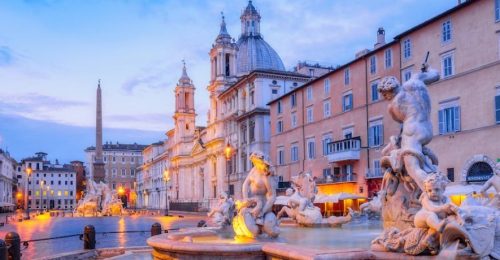
Beyond Rome: A Region of Coast and Hills
Lazio is the region of central Italy that surrounds Rome, its capital, running from the Tyrrhenian coast inland to the foothills of the Apennines. With about 5.7 million residents, it combines the capital's grandeur with a quieter hinterland of hill towns, lakes, abbeys and long sandy beaches. Its history is layered: Etruscan cities, Roman villas, papal strongholds and medieval hilltop communities all lie within a day's reach of one another, which makes the region unusually rewarding for visitors who like to build an itinerary around ideas rather than a single address.
Heritage is everywhere. Tivoli, a short distance east of Rome, holds the Renaissance Villa d'Este, famed for its terraced gardens of fountains, and Hadrian's Villa, the Roman emperor's sprawling retreat, both UNESCO World Heritage Sites. Cerveteri and Tarquinia preserve Etruscan necropolises inscribed by UNESCO in 2004. Further south the Abbey of Montecassino crowns its hill above the Liri valley, and in the north Viterbo, the medieval city of the popes, is surrounded by thermal springs and honey-coloured stone.
Lakes, Islands and the Roman Table
Water shapes much of Lazio's appeal. Lake Bolsena and Lake Bracciano are broad, clear lakes ringed by medieval towns, with lakeside promenades and small beaches. The Pontine Islands, including Ponza and Ventotene, lie off the southern coast and are reached by ferry from ports such as Anzio, Formia and Terracina. On the mainland, Sabaudia and the Circeo National Park combine dunes, lagoons and forest, while Sperlonga and Gaeta offer whitewashed lanes and sandy bays. An airline serving Rome can present all of this as an easy add-on within a short drive of the airport.
Food and wine follow the landscape. The Castelli Romani hills south-east of Rome produce Frascati, the pale white wine long poured in the capital's trattorias, and their osterie serve porchetta from Ariccia. Amatrice gave its name to the sauce amatriciana, while the Sabine hills yield prized olive oil. Lake and coastal restaurants add fresh fish, and everywhere the cooking echoes Rome's own: pecorino, artichokes, wild greens and slow-cooked lamb. For visitors who think in terms of regions, Campania begins just beyond Lazio's southern edge.
Seasons, Routes and Weekend Escapes
Spring and autumn are ideal for exploring Lazio's villas, abbeys and hill towns, with mild days and clear light, while late spring through September suits the coast and the islands. Many of the region's best places lie within an hour or two of Rome, so a city stay can easily be extended into a lakeside weekend or a beach break. The Pontine Islands are at their liveliest in summer, whereas the Castelli Romani and Viterbo area reward visitors throughout the year, especially at harvest time.
Rome's Fiumicino and Ciampino airports are the gateways, with direct flights from the UK taking around two and a half hours to the capital. Regional trains and roads then fan out to the coast, the lakes and the hills. A destination name such as VisitLazio.co.uk would give tourist boards and hotels a single place to join these threads together, and the wider guide to Italy shows how the region links with Tuscany to the north and the south beyond.
Where to Stay Across Lazio's Landscapes
Lazio gives travellers an unusually wide choice of bases. Rome is the obvious hub, but the region rewards those who sleep elsewhere. Lakeside towns on Bolsena and Bracciano suit couples and families who want water, small beaches and medieval streets, while Viterbo offers historic stays near thermal springs. The Castelli Romani hill towns, such as Frascati and Castel Gandolfo, give cool, green settings with views back towards the capital. On the coast, Sperlonga and Gaeta bring sandy beaches, and the Circeo area around Sabaudia offers dunes and a national park. Many properties here are converted villas, farmhouses and convents, with a lived-in warmth that city hotels cannot match.
The islands offer a different kind of retreat. Ponza, the largest of the Pontine Islands, has pastel harbour houses, small hotels and coves that suit couples, divers and boat lovers, while Ventotene is smaller and quieter. Golfers will find courses within reach of Rome, and wellness travellers can build a stay around thermal baths near Viterbo, a tradition that stretches back to Roman times. For groups and families, countryside villas with pools are a popular choice. The tourist board opportunity is clear: one region, with a base for every kind of traveller, within a short drive of a major airport.
Porchetta, Pecorino and Festival Days
Lazio's culinary identity is rooted in simple, robust ingredients. Porchetta, slow-roasted herbed pork sliced into rolls, is a hill-town speciality, particularly around Ariccia, and Roman-style pizza, thin and crisp, is a regional favourite. Buffalo mozzarella from the southern plain, artichokes from Ladispoli and Sezze, kiwi and olive oil from the Sabine hills and chestnuts from the hill country all feature. Viterbo's table brings lake fish and hearty pasta, and coffee bars everywhere serve the morning ritual. Sweet tooths are rewarded with ciambelline, ring-shaped biscuits, and bread from Genzano, one of the few Italian breads with a protected status.
The calendar is full of local celebrations. In Viterbo, the September Macchina di Santa Rosa carries a tall illuminated tower through the medieval streets in a ceremony of striking spectacle, while Genzano's Infiorata, a carpet of flower petals laid across a street in June, is a floral spectacle in the Castelli Romani. Summer brings concerts in Roman villas and the amphitheatres, autumn gives chestnut and wine festivals, and spring suits garden visits at Tivoli and Villa Lante at Bagnaia. Craft traditions include ceramics in Civita Castellana, and a base in Rome puts all of this in easy reach. Those continuing north can plan time in Tuscany.
Hiking, Sailing and Roads Less Followed
Lazio is a region for active, themed travel. Walkers can follow the Via Francigena, the historic pilgrim route that crosses the north of the region from Lake Bolsena to Rome, while cyclists will love the flat lakeshore circuits at Bracciano and the Appian Way Regional Park. Monte Circeo and the Simbruini Mountains give proper hill walking, and in winter the Terminillo massif near Rieti offers skiing within a morning's reach of the capital. Divers and snorkellers head for Ponza, where clear water and sculpted cliffs create dramatic seascapes, and sailors can charter from marinas along the coast, linking harbour towns by day.
Day trips are easily stitched together. Tivoli and its gardens, Ostia Antica and the Etruscan sites at Cerveteri and Tarquinia make a cultural triangle, while the lakes, abbeys such as Subiaco and Farfa and the walled town of Anagni suit slower days. Food and craft trails run through the Castelli Romani and the Sabine hills. A hotel could package a week as three mini-stays: city, lake and sea. The coast near Sperlonga gives the beach finale, and Campania's Naples is a natural extension. Operators can feature the whole region through the AI platform, which builds routes around each traveller's interests.
Planning your stay
Lazio is the region whose capital is Rome, and its other highlights are within a day trip of the city. Tivoli has Hadrian's Villa and the Renaissance gardens of Villa d'Este, Ostia Antica is a well-preserved Roman port town, and the Castelli Romani hill towns offer wine and lake views. Viterbo and the northern lakes have a quieter, medieval feel.
The coast stretches south to Sperlonga, Gaeta and the Pontine islands, and beyond lies Campania and Naples. Staying outside the capital gives travellers cheaper rooms and easier parking, though trains into Rome remain essential for sightseeing.
When to go
Lazio has more variety of season than many visitors expect. Winter days around Rome can be bright and quiet, the hill towns are at their best in spring and for autumn food festivals, and the coast has a long summer. Planning a trip around one theme, such as archaeology, wine or beaches, keeps the transport manageable.
Spring and autumn suit sightseeing and walking, and the coast is best from June to September. July and August are hot, and the beaches near Rome are crowded at weekends. Many seaside businesses close in winter, while the inland towns and archaeological sites stay open.
Take care when visiting or driving through woodland areas, and report fires to the emergency services. Across Lazio, heavy rain in winter can cause local flooding.
Getting around
Regional trains from Rome serve Ostia Antica, Tivoli buses leave from the city, and coastal towns are reached by train and local bus.
Watch for restricted traffic zones. Never leave luggage in a vehicle, even out of sight in the boot.
Before you travel
Entry requirements and official travel guidance are updated regularly, so check the latest position with your government before booking. The sources we used are listed at the foot of this page.
Why Lazio matters to the industry
Lazio is where Rome's visitor numbers can spill into smaller towns and coastal stays. VisitLazio.co.uk lets a tourist board, hotel group or airline publish clear answers on day trips and seasons, and our AI platform carries them to assistants.
Explore our other destination guides, or read the OTA page on how booking platforms can promote lesser-known regions.
Questions travellers ask about Lazio
What are the best day trips from Rome in Lazio?
Popular choices include Ostia Antica, Tivoli with Hadrian's Villa and Villa d'Este, the Castelli Romani hill towns and the coast around Sperlonga. Check opening times and transport before you travel.
What is Lazio best known for?
Lazio is best known as the region around Rome, with UNESCO sites at Tivoli and Cerveteri and Tarquinia, the Abbey of Montecassino, the Pontine Islands, lakes such as Bolsena and Bracciano, Frascati wine and a long sandy coast including Sperlonga.
How do I get around Lazio from Rome?
Rome is the natural base, with trains and roads reaching Tivoli, the Castelli Romani, Viterbo and the coast in an hour or two. Ferries to the Pontine Islands leave from ports such as Anzio, Formia and Terracina.
Where should I stay in Lazio outside Rome?
Lakeside towns on Bolsena and Bracciano suit couples and families, the Castelli Romani hills give cool, green villas near the capital, and Sperlonga and Gaeta bring sandy beaches. Ponza is the choice for island stays, with small hotels and clear water.
What food should I try in Lazio?
Try porchetta from Ariccia, Roman pizza, buffalo mozzarella, artichokes, pecorino and Sabine olive oil. Viterbo adds lake fish and hearty pasta, and Genzano's protected bread is a local treat.
In the Visit Travel Group portfolio: VisitLazio.co.uk.