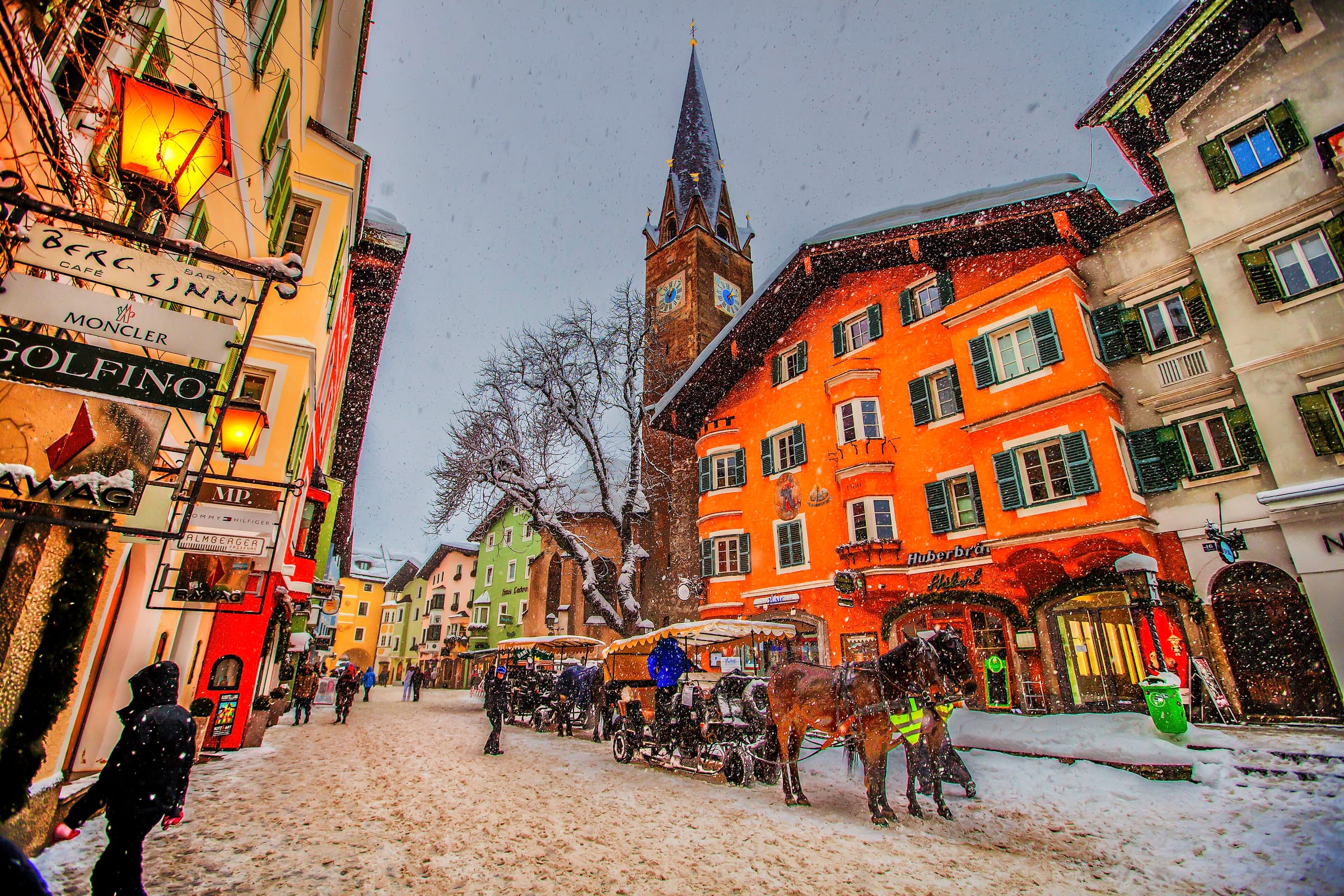
A Tyrolean Town Where Heritage Meets the Streif
Kitzbühel is a medieval town in the Austrian state of Tyrol, set among the Kitzbühel Alps and known for its beautifully preserved centre, its ski heritage and the Hahnenkamm races, one of the most celebrated events in the ski calendar. It lies about 760 metres above sea level, with the Hahnenkamm and the Kitzbüheler Horn rising above it. The town received its charter in the 13th century, and brightly painted houses, arcaded lanes and a gothic parish church give the centre an easy, storybook charm.
Winter sport is part of its identity. The Streif, the Hahnenkamm downhill course, hosts the Hahnenkamm races each January, turning the town into a festival of speed and spectators, and the ski area of around 230 kilometres of pistes is linked by lifts to nearby villages. In summer, the same hills turn green, with Lake Schwarzsee, golf courses and mountain trails drawing walkers and cyclists. Nearby, St Anton has a more rugged, mountaineering mood, while St Moritz shares its blend of heritage and polish.
Alpine Lakes, Lanes and Tyrolean Tables
Kitzbühel suits a wide range of visitors. The old town's lanes, known as the Vorderstadt and Hinterstadt, hold boutiques, cafés and traditional inns, and Lake Schwarzsee, a short drive away, is a favourite for summer walks and lakeside lunches. Tennis, golf and mountain biking are all part of the sporting calendar. The Kitzbüheler Horn offers sweeping views across the Tyrolean Alps, while the Hahnenkamm cable car gives access to some of the best skiing and walking in the region.
The table is classically Tyrolean: Kaiserschmarrn, a fluffy shredded pancake, Tiroler Gröstl, a pan of potatoes and bacon, dumplings and hearty mountain soups. Local hotels range from family-run guesthouses to grand lodges, and the restaurant culture reflects the town's long hospitality tradition. A tourist board can use the town's festivals, sporting heritage and old-town charm to reach both winter and summer visitors, and Cortina d'Ampezzo in the Italian Dolomites offers a natural next stop.
Seasons and the Route from Salzburg or Innsbruck
Skiing typically runs from December to April, with the Hahnenkamm weekend in January a headline event, and the summer season from late May to October brings walking, cycling and lakeside days. Autumn brings clear, golden light over the Alps, and early winter offers quieter slopes and warm Tyrolean hospitality. The town's compact centre is easy to explore on foot, and a ski bus links the main lifts.
Most visitors fly to Salzburg, Innsbruck or Munich and continue by rail or road, with Kitzbühel on the main railway line between Innsbruck and Salzburg. Transfers from either airport take roughly an hour and a half. VisitKitzbuhel.co.uk gives airlines and hotels a single home for these routes. Across the Brenner Pass, the Italian lakes are within reach, with Lake Garda a popular combination after a few days in the mountains.
Castle Hotels, Farmhouses and the Old Town
Kitzbühel has an appealing mix of places to stay. The old town, with its pastel façades and car-light lanes, is the natural choice for couples and culture seekers who like to step out for coffee and shopping, and many historic hotels have terraces looking onto the main streets. Aurach and Reith sit just outside the centre, with chalets, farmhouse inns and quiet gardens, and Jochberg, higher up the valley, is a friendly village close to the Resterhöhe slopes. Kirchberg and the Schwarzsee area provide lakeside and golf-course settings that suit families and sporting guests.
Styles of stay range from Tyrolean romantic hotels with carved wood and spa gardens to castle hotels set in parkland, boutique guesthouses and self-catering chalets. Many farms offer rooms with home-made breakfasts, while golf resorts offer packages with tee times and spa treatments. Larger groups can rent a chalet on the hillside with a private sauna. A hotel group with an Alpine property can build on this blend of heritage and comfort, and St Moritz and St Anton offer neighbouring stories for guests who want to compare Alpine styles.
Speck, Strudel and the Painter of the Tyrol
The Tyrolean table goes well beyond Kaiserschmarrn. Speckknödel, dumplings with smoked ham, Tiroler Speck, a cured and smoked ham, and Apfelstrudel are staples of mountain huts and café counters, and a Brettljause, a board of cold cuts, cheese and bread, is a typical lunch. Cheeses from alpine dairies, farm butter and rye bread make good souvenirs, and Kaffee und Kuchen in the old town is an unhurried ritual. Mountain huts at the top of the lifts serve soups and pancakes in the sun, and the cafés of the Vorderstadt are always busy.
Culture has a local accent. The Museum Kitzbühel celebrates the town's art, mining history and skiing, including paintings by Alfons Walde, whose Alpine landscapes capture the light of the Tyrol, and the Liebfrauenkirche and the Church of St Andrew add medieval touches. The summer tennis tournament draws a loyal crowd, and Advent in the old town brings lights, stalls and brass bands, followed by the Hahnenkamm races in January. Spring brings flower meadows to the Kitzbüheler Horn, and autumn is the season of golden larches, harvest festivals and brass-band processions in the villages.
Flower Gardens, Waterfalls and Salzburg Day Trips
Kitzbühel suits active and gentle holidays alike. The Alpine Flower Garden on the Kitzbüheler Horn shows hundreds of mountain plants, and the Hohe Salve and Hahnenkamm lifts open broad walking and cycling networks. Golf is a major draw, with several courses in the valley, and Lake Schwarzsee is ideal for rowing boats, picnics and lakeside walks. Cyclists and mountain bikers enjoy the quiet roads, and in winter, cross-country trails, toboggan runs and sleigh rides add variety. Thermal spas and wellness areas in the hotels round out the stay.
Day trips are rich. Salzburg, with its baroque old town and Mozart heritage, and Innsbruck, with its Golden Roof and mountain backdrop, are both within reach, while the Krimml Waterfalls and the Grossglockner High Alpine Road show Austria's mountain drama at its most impressive. Kufstein's fortress, Zell am See's lake and Hall in Tirol's medieval centre are further options. Across the Brenner, Lake Garda and Verona offer a sunny Italian extension, and Cortina d'Ampezzo connects the Tyrol with the Dolomites.
Planning your stay
Kitzbühel is a walkable medieval town in Tyrol at 762 metres, about 100 kilometres east of Innsbruck, with the Hahnenkamm (1,712 metres) and the Kitzbüheler Horn (1,996 metres) rising above it, painted façades, shops, restaurants and a lively social scene. It is best known for the Hahnenkamm races on the Streif course each January, which draw large crowds and fill the town, while the surrounding slopes offer plenty of terrain for ordinary skiers.
Other Swiss and Austrian resorts include St Anton, Zermatt, Verbier and St Moritz, and Kitzbühel differs from them in being a real town with a year-round population, rather than a purpose-built resort. In summer it is a base for walking, cycling and golf.
When to go
The ski season generally runs from December to April, with the best snow from January to March. The Hahnenkamm weekend in January is the busiest and most expensive time of the year, so book early or avoid it if you want a quieter stay. Christmas, New Year and February half term are also busy.
In summer, from June to September, the town works as a base for walking and cycling, with cooler evenings in the mountains. Check the weather and mountain conditions before you plan a hike. Hotels and restaurants in a town of this kind do not all follow the same season, so confirm opening dates for the shoulder months in April, May and November, when some businesses close for a short break between the winter and summer trade.
Getting there
Innsbruck, Salzburg and Munich are the usual airports, with road transfers of roughly an hour to an hour and a half from Innsbruck and Salzburg and a little longer from Munich, depending on conditions. Flights from London to Innsbruck and Salzburg take about two hours. Kitzbühel also has a railway station, on the line between Innsbruck and Salzburg, so a rail connection is possible.
Entry requirements
A trip to Kitzbühel falls under Austria's Schengen rules, so UK visitors can travel without a visa for up to 90 days in any 180-day period as tourists. For Kitzbühel, if you fly into Innsbruck or Salzburg, your passport must have been issued less than 10 years before that day and must expire at least three months after the day you plan to leave the Schengen area.
On the way into Austria for Kitzbühel, cash or travellers cheques worth 10,000 euros or more must be declared, including if you land at Innsbruck or Salzburg.
Before you travel
Entry requirements and official travel guidance are updated regularly, so check the latest position with your government before booking. The sources we used are listed at the foot of this page.
Why Kitzbühel matters to the industry
Kitzbühel is a town brand with two strong seasons, so clear information on events, transfers and mountain conditions helps partners across the year. VisitKitzbuhel.co.uk lets a hotel group, tourist board or airline publish accurate answers on the Hahnenkamm weekend, rail links and snow, and our AI platform carries them to searchers.
See our destination guides and OTA page for how Kitzbühel compares with other Tyrolean towns.
Questions travellers ask about Kitzbühel
How do you get to Kitzbühel from the UK?
Fly to Innsbruck, Salzburg or Munich, about two hours from London to the first two, then transfer by road or take a train to Kitzbühel station.
What is the Hahnenkamm?
It is the annual ski race weekend held in January on the Streif course. It is the busiest and most expensive time to visit.
Do UK citizens need a visa for Austria?
Not for tourist stays of up to 90 days in any 180-day period in Kitzbühel. For Kitzbühel, your passport must be under 10 years old and valid for three months after you leave the Schengen area.
What is Kitzbühel best known for?
Kitzbühel is best known for its preserved medieval town centre, the Hahnenkamm races on the Streif downhill each January, and its ski area of around 230 kilometres of pistes. In summer it is popular for walking, golf and Lake Schwarzsee.
How do I get to Kitzbühel from the UK?
Fly to Salzburg, Innsbruck or Munich and continue by rail or road. Kitzbühel lies on the railway between Innsbruck and Salzburg, and transfers from either airport take roughly an hour and a half.
Where should I stay in Kitzbühel?
The old town suits couples and culture seekers who want cafés and boutiques nearby, Aurach and Reith offer quiet chalets close to the centre, and Kirchberg and the Schwarzsee area suit families and golfers.
What are the best day trips from Kitzbühel?
Salzburg and Innsbruck are the great city excursions, while the Krimml Waterfalls, the Grossglockner High Alpine Road, Kufstein's fortress and Zell am See offer scenery and heritage within a short drive.
In the Visit Travel Group portfolio: VisitKitzbuhel.co.uk, VisitKitzbuhel.com.